Syllables in Lyrics: Make Words Fit the Rhythm
Learn to count syllables in song lyrics, hear natural word stress and fix crowded lines. Includes an eight-syllable example and a practical vocal test.
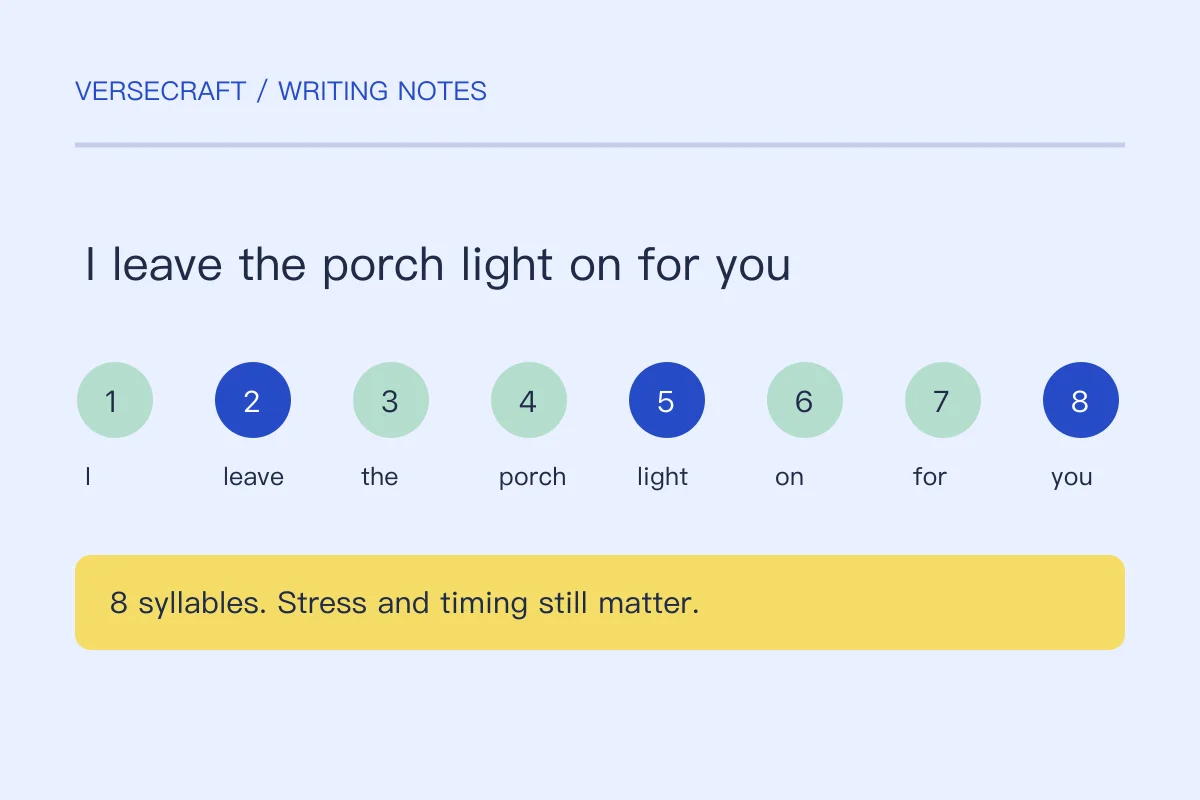
Counting syllables helps you compare lyric lines, but rhythm also depends on stress, note length, rests and delivery. Two lines can contain eight syllables and still feel completely different when sung. Use a count to find possible problems, then use your voice to decide what needs changing.
This guide focuses on English phrasing. Other languages organize stress and timing differently; translating a lyric usually requires a new vocal test rather than a matching word count.
Syllables, beats and notes are different units
A syllable is a spoken unit, a beat is part of the music’s pulse, and a note can be shorter or longer than a beat. One syllable may stretch across several notes. Several syllables may also fit within a single beat.
Start with an original line: “I leave the porch light on for you.” In ordinary speech, it has eight syllables: I / leave / the / porch / light / on / for / you. That count does not tell you where the melody starts, how long “light” lasts or whether there is a rest before “you.”
As a practice pattern, place “I leave the porch light” in one four-beat bar and “on for you” in the next, leaving space afterward. Then try the whole line across one bar. Neither version is automatically correct; compare clarity, breath and emotional effect.
Count what you actually pronounce
Read the line slowly in your intended accent. Tap once for each spoken syllable. Avoid using spelling or dictionary divisions as the only test: words such as “fire” and “every” can vary in casual or sung pronunciation.
If you compress a word to make a phrase work, be sure you can repeat that delivery consistently. Keep the pronunciation believable for the singer. Changing a normal word into an awkward sound merely to satisfy a counter usually creates a new problem.
For names, abbreviations and mixed-language lines, write down the intended pronunciation. A text counter does not know whether an abbreviation is spoken as a word or as separate letters.
Mark natural stress before changing the count
In ordinary English speech, TA-ble and be-LIEVE have different stress patterns. A melody can deliberately play against speech, but accidentally emphasizing a weak syllable may make a phrase hard to understand.
Speak your sentence as if telling someone something important. Circle the words that carry the meaning. In “I leave the porch light on for you,” you might emphasize “leave,” “light” and “you,” depending on the context. A different emphasis can even change whom the line seems to reassure.
Now sing the line. Are the important words audible and well placed? If the melody forces “the” to carry all the weight, try moving the phrase, changing the melody or choosing different wording before cutting random syllables.
Repair a crowded line without losing its image
Consider this deliberately wordy draft: “I am still leaving the little porch light on for you.” The line contains several words that may compete for a short phrase.
Try three revisions with different purposes:
- “I leave the porch light on for you.” Keeps the action and recipient.
- “The porch light waits for you.” Shortens the line and gives the object a role.
- “I leave a light.” Creates space, but loses the specific porch and person.
Choose by what the section needs. The shortest version is not necessarily best. If the porch is the central image, keep it and remove a less important word elsewhere.
Our lyric revision guide helps preserve a narrator’s voice while you make these changes.
Compare repeated sections
When two verses use the same melody, corresponding lines often benefit from compatible stress patterns and phrase lengths. They do not always need identical counts. A pickup, a rest or a small rhythmic change may accommodate a difference.
Read verse two over verse one’s melody. Mark only the phrases that cause a real difficulty. Rewrite those phrases first, rather than flattening every line into the same number of syllables.
The line-level counts in the lyrics editor are estimates. They are useful as a warning that a line suddenly became denser, not proof that a lyric will fit a tune. Always confirm counts and phrasing with the intended pronunciation.
A five-pass vocal test
- Speak the lyric naturally without music.
- Tap a steady pulse and speak it again.
- Mark meaningful stresses and planned breaths.
- Sing or rap it with the actual melody or beat.
- Record a take and listen for words that disappear or rush.
Change one line, then retest the transition into and out of it. A line that works alone may still interrupt the section. For a full arrangement, pair this exercise with the song structure guide.
Is eight syllables the ideal line length?
No. Eight is a convenient exercise. A short hook, conversational verse and dense rap passage have different needs. Pick a phrase that fits the music and leaves the singer room to deliver it.
Can a syllable counter check Chinese lyrics?
Character counts can provide a rough reference for many Mandarin lines, but characters, pronunciation and musical syllables are not universally interchangeable. Other Chinese varieties and mixed-language writing need their own checks. Listen to the intended delivery rather than assuming an English counter transfers accurately.
Further reading: Pat Pattison’s Berklee Online discussion of prosody provides a broader framework for aligning musical choices with the song’s intent. The counting and revision exercises here are original.