Rhyme Schemes for Songs: AABB, ABAB and ABCB
Compare AABB, ABAB and ABCB rhyme schemes with original song examples. Learn perfect, slant and internal rhyme, then revise a stanza without forcing it.
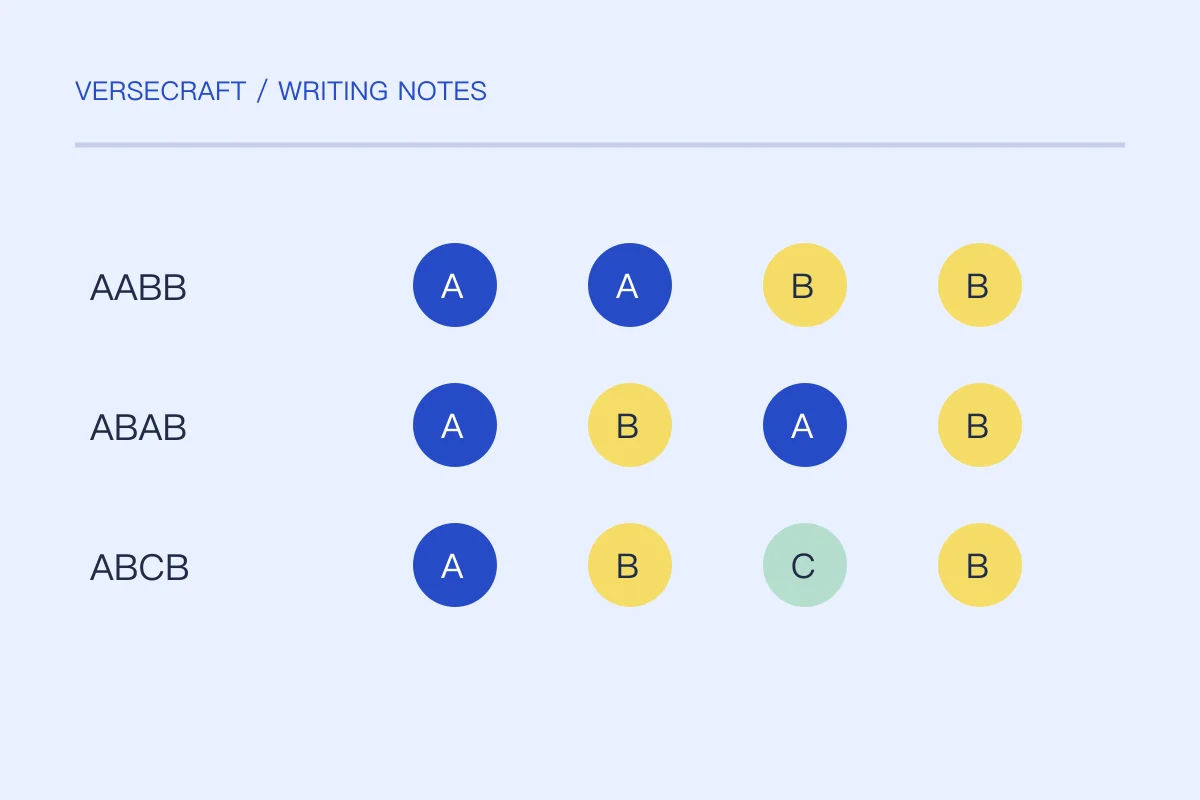
A rhyme scheme describes the pattern of end sounds in a set of lines. Give the first sound the letter A, the next different sound B, and reuse a letter when a sound returns. AABB makes two adjacent pairs; ABAB alternates them; ABCB connects only lines two and four.
Choose a pattern after you know what the stanza needs to say. It is easier to change a rhyme than to rescue a verse whose meaning disappeared while you searched for matching words.
Hear the sound rather than the spelling
In English, rhyme depends on pronunciation. “Blue” and “through” rhyme despite different spellings. “Love” and “move” look related but do not normally share the same stressed vowel. Your accent and intended pronunciation matter.
A perfect rhyme matches the stressed vowel and the sounds after it, with a different beginning: “gate” and “late,” for example. A slant or near rhyme makes a looser connection. “Home” and “alone” share a vowel in many English accents but have different final consonants.
Slant rhyme is a broad label; writers do not all divide rhyme categories in exactly the same way. The useful test is what the connection sounds like when delivered in your song.
AABB: connect two short thoughts
Each neighboring pair shares an ending. This makes it easy to group a setup and response or to deliver two related observations. Here is an original practice stanza:
You left your coat beside the gate — A
I missed the train and called it fate — A
The kettle filled the silent room — B
The basil on the sill would bloom — B
The pairs close quickly. That can support a clear, conversational verse, but four predictable pairings in a row may feel too tidy for an unsettled story. Try letting a thought continue across the line ending, or change one pair to a near rhyme.
ABAB: delay the return
Alternating rhyme asks the listener to hold the first sound until line three. The delay can give a longer thought space to develop:
The platform shone with evening rain — A
Your coffee warmed my empty seat — B
I learned the sound of every train — A
Before I heard you on the street — B
The connected end sounds are rain/train and seat/street. Notice that an end rhyme is not the entire sentence. You can keep the sound pattern while changing the action, the line length or the point of view.
ABCB: leave room for natural language
Only lines two and four need to share an end sound. Lines one and three are independent. Some writers label the same open-ended arrangement XAXA or XBXB; follow the stated convention rather than treating the letters as musical rules.
For practice, write four lines whose final words are door / rain / quiet / train. Keep lines one and three free, and let line four answer the situation introduced in line two. This gives you fewer rhyme obligations and more choice about what the singer says.
Internal rhyme can move the energy inside a line
End rhyme links line endings. Internal rhyme connects sounds within a line or phrase: “Cold road, slow steps, I count the lights.” Cold/road/slow create related sounds without requiring the final word to complete that chain.
In rap, the placement of those sounds against the beat is as important as their presence. Start with a short phrase you can deliver clearly. Add one internal connection and listen again. More rhymes can make a passage denser, but density is not automatically better flow. See the rap lyric exercise for a beat-based approach.
A revision method that protects the meaning
Write the line first without a rhyme. Suppose you want to say, “I keep arriving at your old address.” Circle the important thought: a habit that has not caught up with a change.
Build possible end words around that meaning: door, street, home, turn, key. Make several sentences before choosing a pair. “My hands still make the same wrong turn” might fit the story better than a perfect rhyme that introduces an unrelated “burn.”
Use the rhyme workbench to explore possibilities, then say each candidate in the whole stanza. Reject any version you cannot explain in ordinary speech. Check syllables and word stress after the meaning is clear.
A short practice session
- Write four plain sentences about waiting at a station.
- Arrange one version as AABB and another as ABCB.
- Keep the same event and point of view in both.
- Read each over the same pulse, without adding a melody to hide awkward words.
- Choose the version whose phrasing feels most believable.
Can I change rhyme schemes between sections?
Yes. A tightly paired chorus and a looser verse can create contrast. Keep enough consistency within a section for its sound pattern to feel intentional.
Are slant rhymes a mistake?
No. They can preserve natural wording or leave a less resolved sound. Judge the actual delivery rather than whether two words look like a perfect pair on the page.
For a more detailed discussion of rhyme and emotional intent, read Pat Pattison’s Berklee Online lesson on prosody. All practice lines above are original to this guide.