How to Write Rap Lyrics: Bars, Flow and Rhymes
Write rap lyrics to a beat with a practical guide to bars, flow, internal rhyme and hooks. Build an original eight-bar verse and test it aloud.
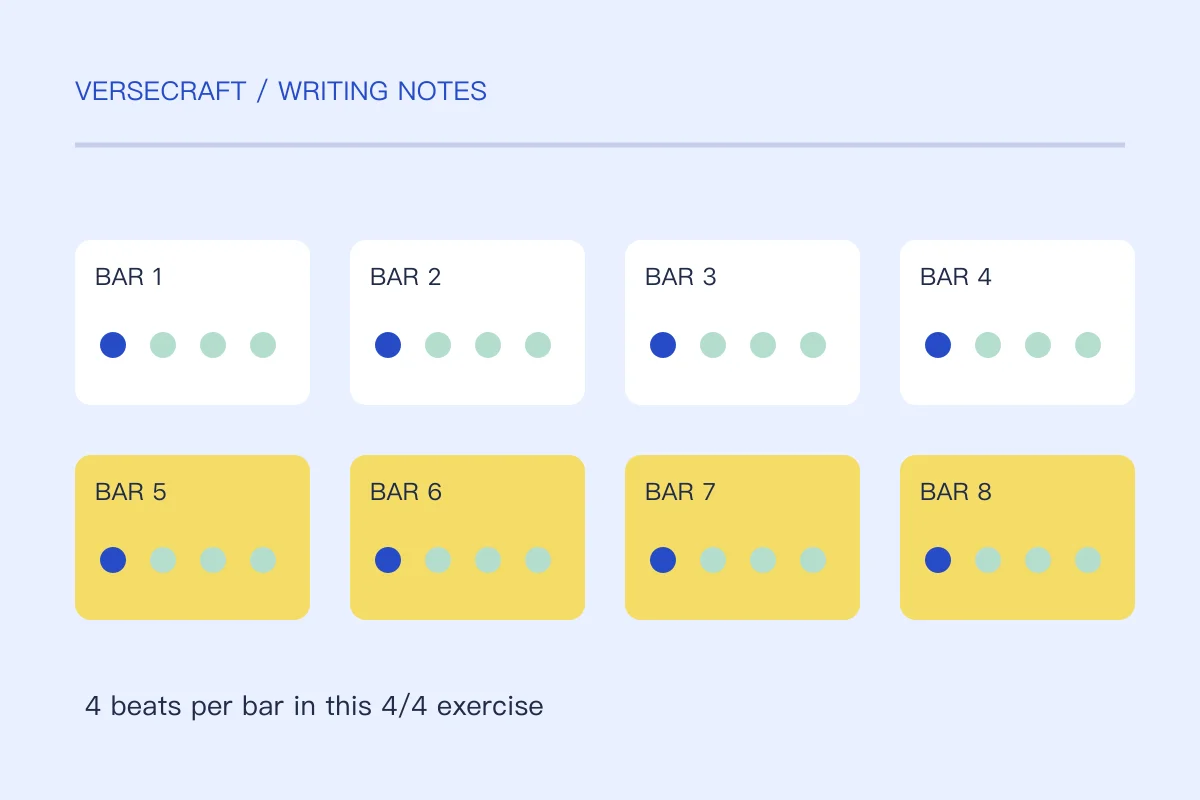
To write rap lyrics, establish a beat, choose a clear point and speak a short rhythmic phrase before filling a page with rhymes. Flow comes from how syllables, stresses and pauses move against the beat. Fast delivery and dense rhyme are options, not entry requirements.
The exercise below builds eight bars about taking the last bus home after a difficult shift. It is a writing drill with original lines, not a performance template for every kind of rap.
Count the beat before counting lines
For this exercise, choose an instrumental in 4/4 at a comfortable tempo, perhaps 80–90 BPM. Count “one, two, three, four” with the pulse. Those four beats make one bar in this time signature. Count eight bars and notice where the instrumental repeats or changes.
One written line does not always equal one bar. A sentence can start before the bar, run across two bars or finish early and leave a pause. Initially, writing one short phrase per bar makes the relationship easier to hear.
Use an instrumental you are allowed to practice with. Public release has separate requirements; an exercise over a beat does not establish permission to distribute a recording made with it.
Give the verse a small narrative route
“Working hard” is broad. “I clock out, miss a call, and decide to take one small step toward a different job” gives the verse a direction. Divide eight bars into four stages:
- Bars 1–2: where the speaker is.
- Bars 3–4: what is pressing on them.
- Bars 5–6: what they notice or reconsider.
- Bars 7–8: what they decide to do.
The route prevents each bar from becoming a separate slogan. A boast, a joke or an image earns its place when it develops the speaker’s point.
Find a flow with a rough vocal sketch
Loop the beat and speak a few ordinary words about the scene. You can use placeholders while locating the entrances and pauses. Save one pattern that you can repeat without rushing, then fit a clear sentence into it.
Try this original opening slowly: “Last bus, wet cuffs, coins in my hand.” The related sounds in bus/cuffs and the short opening phrases create possible rhythmic material. Do not force every syllable onto a strong beat. Experiment with a gap after “wet cuffs,” then enter the next phrase later.
If you keep running out of breath, shorten a phrase or leave a larger pause. A useful delivery should be repeatable at a comfortable level; pushing harder is not the only fix.
Build the rhyme around the thought
Choose end words that belong in your scene: hand, stand, phone, home, shift, lift. Make a small family of possible phrases rather than writing an unrelated line simply because its last word rhymes.
“Late shift, same lift, fourth-floor light” uses shift/lift inside a phrase. It still needs to mean something in the verse. Internal rhyme can add movement, but a line with fewer rhymes may communicate more clearly.
For sound patterns, compare AABB, ABAB and ABCB. For delivery, use the syllable and stress test. These solve different problems.
Sketch eight bars, then perform them
Here is a starting outline with one original phrase per practice bar:
- Last bus, wet cuffs, coins in my hand
- One more shift with a change of plan
- Missed your call by a quarter to ten
- Said “next week,” then I said it again
- Rain writes lines on the window glass
- I watch my stop and the doubts go past
- Save that listing, send one reply
- Small step home, but the choice is mine
This is intentionally a draft. The end connections become looser toward the close, and line six is more abstract than the opening. Try replacing “the doubts go past” with a physical action. Then test whether the new wording fits the same rhythmic space.
The bar numbers organize this exercise; they do not prove the phrases fit any particular instrumental. Record all eight over your chosen beat before making that judgment.
Write a hook that the verse can support
Pull out the clearest short idea, such as “One reply” or “Small step home.” Repeat it over a contrasting rhythm, then ask whether it captures the decision in the verse. A hook can be sung, rapped or spoken; it does not need to summarize every detail.
Try a topic and constraints in the rap lyrics workbench, or browse the rap writing page. Keep your strongest line, revise the surrounding phrases and export a text copy for rehearsal.
Does a rap verse have to be 16 bars?
No. Sixteen bars is a useful familiar practice format. Eight bars can teach the same basic skills on a smaller scale. Choose the final length by the beat, arrangement and amount of story you need.
Should I rhyme every line?
You can, but a fixed rhyme count is not a measure of quality. Meaning, timing, variation and intelligibility all matter. Keep the rhyme that improves the passage when performed.