Song Structure Guide: Verse, Chorus and Bridge
Understand verse, chorus, pre-chorus and bridge with three song structure templates, an original lyric outline and practical arrangement decisions.
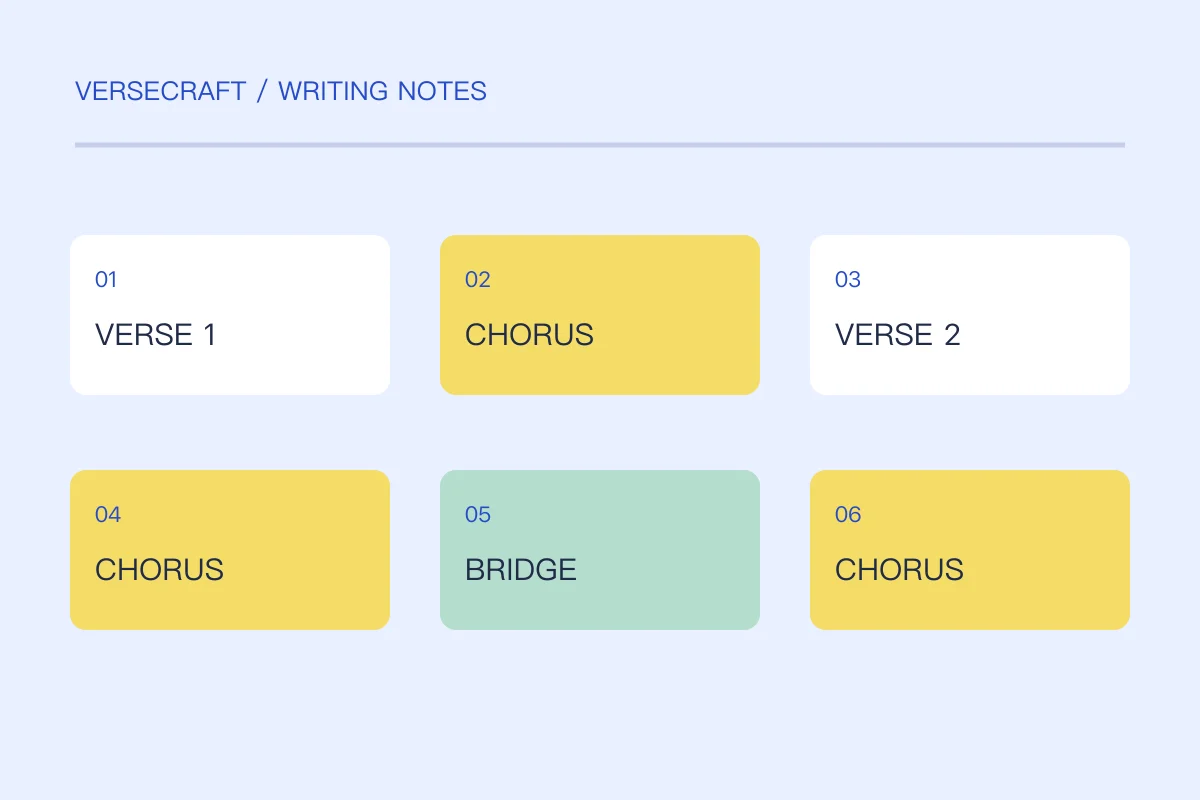
Song structure is the order of a song’s sections. A verse usually develops the situation, a chorus returns to a central idea, and a bridge introduces contrast before a later return. These are useful writing roles, not requirements that every song must follow.
If your draft contains good lines but seems to wander, decide what changes between sections. You do not need more lyrics until you know what the next section should accomplish.
What each song section does
Verse: introduces or develops an event, setting or point of view. A second verse usually benefits from adding a consequence, a later moment or a new detail, rather than restating verse one with different furniture.
Chorus: provides a recognizable return. It often carries the title or main emotional statement. Its words may repeat exactly while the verses change how the listener understands them.
Pre-chorus: connects the verse to the chorus. It can raise a question, build tension or narrow the singer’s focus. If the transition already works, you may not need one.
Bridge: changes the perspective, emotional direction, harmony, texture or another meaningful element. A lyrical bridge might admit something the singer avoided earlier. An instrumental bridge can provide contrast without new words.
Intro and outro: establish the entrance and exit. They may be instrumental, contain a short vocal phrase or reuse material from another section. A long explanation in the intro is rarely necessary for a first lyric draft.
Three templates you can actually write into
Template 1: A compact verse–chorus song
Verse 1 → Chorus → Verse 2 → Chorus → Outro.
Choose this when the central idea is direct and the second verse can develop it without a separate turning point. For a first writing session, four lines per section is a manageable constraint. The number is an exercise, not a standard for every genre.
Template 2: A song with a bridge
Verse 1 → Chorus → Verse 2 → Chorus → Bridge → Final chorus.
Use the bridge when returning to the chorus again would otherwise feel emotionally unchanged. For example, the singer might move from blaming another person to admitting their own part in a goodbye.
Template 3: A build into the hook
Verse 1 → Pre-chorus → Chorus → Verse 2 → Pre-chorus → Chorus → Bridge → Chorus.
Choose this when the verse and chorus need a connecting step. A repeated pre-chorus can help establish anticipation. Listen to the whole draft before keeping every section: a template should solve a problem, not create extra work.
An original outline: “The Spare Key”
Imagine a song about returning a key after a breakup. Instead of writing a whole song at once, assign a distinct event or realization to each section:
- Verse 1: the singer finds the key in a winter coat.
- Pre-chorus: they rehearse the message they will send.
- Chorus: “I can give the key back, not the years.”
- Verse 2: they arrive at the door and hear ordinary life continuing inside.
- Bridge: they recognize that keeping the key was delaying their own next step.
- Final chorus: the words can remain, but the delivery becomes more accepting.
The bridge’s change in understanding earns the final return. It does not need to introduce a new character, another location and a second breakup. A single clear turn is often enough.
Try a possible bridge opening: “I called it keeping something safe / I think I meant I couldn’t leave.” These original lines change the singer’s interpretation of the object. Whether they belong in the final song depends on the music and the surrounding lyric.
Section length is a musical decision
A line on the page is not automatically one bar. One long written line may span several bars; two short lines may share a phrase. When you have music, mark where each phrase begins and ends rather than treating the line count as the arrangement.
A 16-bar rap verse is a useful practice format, but it is not a requirement for every rap song. Similarly, a bridge does not need to be exactly eight bars. Draft with simple limits, then keep the length that lets the idea develop without repeating itself unnecessarily.
Use our rap writing walkthrough for counting bars and the syllable and stress guide for matching words to phrases.
How to diagnose a weak arrangement
Read just the first sentence of each section. If every sentence makes the same point, change what happens in verse two. If the chorus introduces so many details that the listener loses the main message, move some into a verse.
Temporarily remove the pre-chorus. Does the chorus still arrive naturally? Temporarily remove the bridge. Does the final chorus lose a necessary shift? This deletion test tells you more than adding sections to meet an expected format.
Then sing the transitions. A change in lyric content alone may not create enough contrast; melody, harmony, groove and instrumental texture can all contribute. A text editor can organize sections, but it cannot judge the finished arrangement by itself.
Try the structure before filling every line
Open the song lyrics workbench and put a one-sentence job under each section label. Draft the chorus’s main idea, write the verse details, then decide whether a bridge has a reason to exist. When the words are ready, see how to prepare lyrics for a song.
Can a song have no chorus?
Yes. Verse-based, refrain-based and through-composed forms can work without a distinct repeating chorus. Make the listening journey clear through other devices, such as a recurring line, melody or developing narrative.
Is a bridge the same as a pre-chorus?
Usually they serve different roles. A pre-chorus leads into the chorus and may recur; a bridge commonly supplies a contrasting section later in the song. The useful question is what your section does when heard in context.
Further reading: Berklee Online’s bridge-writing lesson explores contrast and clarity. The templates and “Spare Key” outline here are original teaching examples.