How to Write a Love Song Without Clichés
Write a personal love song using specific memories, a clear point of view and an honest hook. Includes original examples and a dedication worksheet.
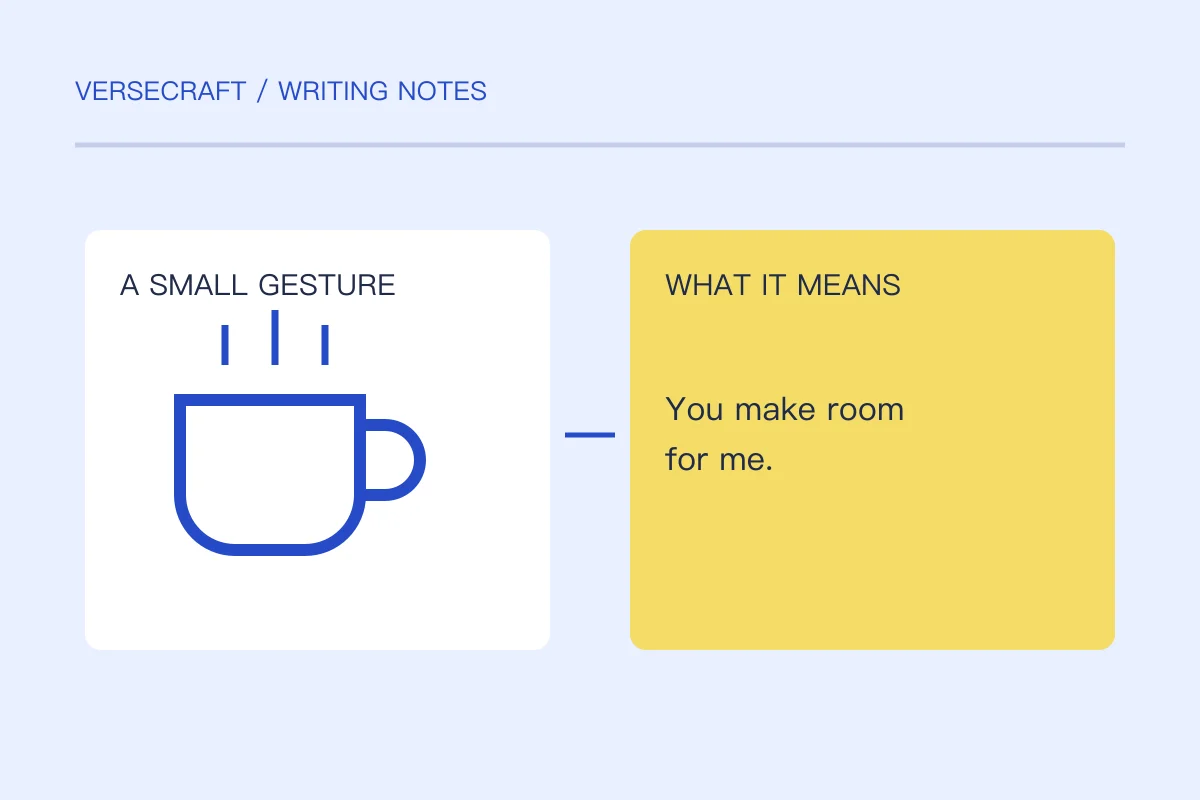
To write a love song that feels personal, start with something one person actually does. Decide whom the singer addresses, choose one emotional promise or question, and let the verse show why the chorus matters. Specificity gives familiar feelings a particular voice.
Love songs can celebrate an established relationship, describe an uncertain beginning, remember someone or admit a difficult goodbye. You do not have to squeeze all of those stages into one lyric.
Choose a moment in the relationship
“You mean everything to me” is a broad statement. A partner leaving an extra mug out, remembering an unusual route home or waiting while you search for your keys can give that statement evidence.
For this original exercise, imagine two people who work different shifts. Their time together is brief, but they keep finding small ways to care for each other. The song’s emotional center is “You make room for me even when our days do not match.”
Write the premise in ordinary language first. If it sounds like a dedication that could be sent to anyone, add a recognizable action. If it reads like a diary with too many names and dates, keep just the detail that carries the feeling.
Make the verse observable
List five things a listener could see or hear. For our scene: two mugs, a cooling kettle, a note by the lock, a chair turned toward the door and a jacket left on a hook.
Now give one of those objects an action. “You turn the kettle on again” shows care more directly than “Your love is a warm ocean.” The metaphor is not banned; it simply needs to reveal something that the literal action cannot already express.
Try a first verse:
Your coat is hanging by the door
I hear the early bus go by
You warm the kettle one time more
And ask about my longest night
The ending uses a loose sound connection rather than a perfect rhyme. Keep or revise it according to the delivery. The scene matters more than forcing the final line to introduce an unrelated “sky.”
Write a promise the singer can believe
A chorus does not need an impossible vow. Instead of promising never to feel afraid or disagree, the singer might promise to return to a conversation, make time or keep showing up.
Possible hooks for this scene include “You leave a little room,” “Our hours find a way” and “The kettle on again.” Each points to a different song. The first is about welcome, the second about persistence, and the third keeps the everyday object at the center.
Test a short original chorus:
You leave a little room for me
When all our hours disagree
No perfect words, no grand parade
Just one more cup before the day
Read it as a draft. “Hours disagree” is figurative; if that feels unlike your narrator, try “When I come home and you must leave.” This loses the easy rhyme but may sound more personal. The chorus revision guide can help you compare the versions.
Replace a cliché by asking for evidence
When you find a familiar phrase, ask what it means in this relationship:
- “You are my world” → What does the person make possible in daily life?
- “I would do anything” → What believable action is the singer willing to take?
- “Time stands still” → What ordinary sound or interruption does the singer stop noticing?
Do not replace every simple phrase with an elaborate metaphor. A plain sentence can be effective after a precise scene has earned it. Repetition can also become meaningful when the second verse adds a new reason to hear the hook.
Write for the actual recipient
For a birthday, anniversary or wedding dedication, choose details the recipient will recognize and feel comfortable hearing. You can change identifying facts and leave private events out. Emotional accuracy does not require publishing every part of a shared story.
Read the lyric as a letter before singing it. Would you stand behind the promise? Does the “you” remain clear? Is the song celebrating the other person, or mostly describing what they provide for the singer?
Use the love song workbench to organize a brief: “Two people work opposite shifts; show care through a kettle and a note; warm but conversational; avoid cosmic imagery.” Keep your own memories in the final draft, and use the song title exercise once the hook emerges.
A dedication worksheet
- Write one sentence about the relationship as it is today.
- List three recurring gestures and choose one.
- Write four lines showing a moment around that gesture.
- State what it means without a metaphor.
- Turn that statement into three chorus hooks.
- Sing your favorite version and remove any promise you do not mean.
Can a sad song still be a love song?
Yes. Missing someone, uncertainty and accepting an ending can all involve love. Choose the emotional direction of this song rather than trying to represent every stage of the relationship.
How do I make it romantic without being cheesy?
Start with a recognizable action and language you would actually use. A listener can feel affection through an ordinary gesture; the lyric does not need to announce how romantic it is.
Further reading: Berklee Online’s love-song lesson discusses getting started with an abstract subject. The shift-work scenario, worksheet and lyrics in this article are original.